Dog Weight Management: The Guide Vets Wish You'd Read (2026)
Here’s the uncomfortable pair of statistics that defines this topic: more than half of dogs are overweight or obese — and the great majority of their owners describe them as “about right.” The gap between those two numbers is the entire problem. We’ve collectively normalized round dogs so thoroughly that a healthy-weight dog now gets called skinny at the park.
The stakes aren’t cosmetic. Landmark lifetime research found that dogs kept lean lived up to two years longer than their moderately overweight littermates — with arthritis arriving years later, too. Two years, purchased with a kitchen scale. Here’s the whole system.
Step 1: Stop Trusting Your Eyes — Score the Body
Fur lies, breed shapes vary, and your eyes have been calibrated by a park full of plump Labradors. Use hands, not vibes — the body condition score (BCS) check takes thirty seconds:
- Ribs: slide fingers along the ribcage. Healthy = ribs felt easily under a light fat layer, like the bones on the back of your hand. Pressing hard to find ribs = excess fat.
- Waist from above: looking down, there should be a visible tuck-in behind the ribs. A straight or bulging profile = overweight.
- Tummy from the side: the belly should slope up from ribcage to hind legs, not hang level or below.
On the 9-point scale vets use, 4–5 is ideal; every point above 5 is roughly 10–15% excess body weight. A dog with no waist and hard-to-find ribs is typically 20%+ over — the equivalent of a 75 kg human carrying 15+ extra kilos.
Step 2: Find the Calories (They’re Hiding in Plain Sight)
Dog weight problems are almost never mysterious. Run a one-week audit — weigh the kibble in grams, log every treat, count the table contributions from every family member — and the culprits appear on schedule:
- The scoop. “One cup” delivered with a heaped mug routinely runs 30–50% over the label’s cup. Grams or nothing.
- The label itself. Feeding-guide ranges skew generous, assume active intact dogs, and don’t know your dog was neutered — which drops calorie needs ~20–30% while appetite rises. The exact post-neuter window is where a puppy’s healthy growth curve most often bends into lifelong excess.
- The treat economy. A dental stick here, a training pocket there, the toddler’s floor donations — in small dogs especially, treats routinely hit 25%+ of daily calories. One cheese cube to a 5 kg dog is, proportionally, a human eating several.
- The multi-feeder household. Dad feeds, then grandma feeds, because the dog — a professional — asked both. If nobody logs feedings, nobody knows. (A shared family log closes this loophole in a week.)
One honest vet visit belongs here too: a small minority of weight gain is medical — hypothyroidism above all — and it’s a blood test, not a guess. Sudden gain, lethargy, and skin changes together mean test first, diet second.
Step 3: The Actual Weight-Loss Protocol
With medical causes excluded and a target weight set with your vet:
- Feed ~80% of maintenance calories for the target weight (not the current one), using a weight-loss or high-protein food if the cut is large — volume and satiety matter for everyone’s sanity.
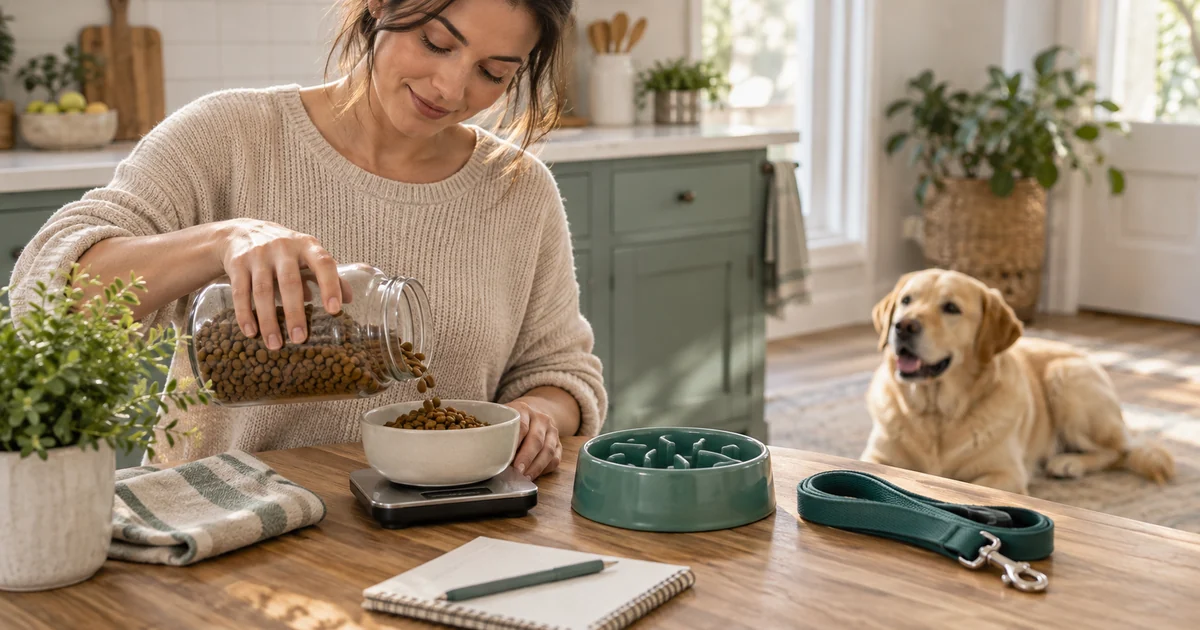
- Gram scale at every meal. The scoop got you here.
- Rebudget treats to ≤10% of daily calories — switch currency to carrot pieces, green beans, or kibble subtracted from dinner. Affection is free; calories aren’t.
- Move more, gently. Add 10–15 minutes of walking per day, building gradually — an overweight dog’s joints need the weight off before high-impact play goes on. Sniffy walks and food-puzzle dinners burn more than you’d think.
- Weigh weekly. Same scale, same time. Target: 1–2% of body weight per week. Faster isn’t better; slower means the audit missed calories.
Expect a plateau around month two or three — the smaller dog burns less. That’s not failure; recalculate maintenance for the new weight and continue. The whole arc for a 20%-overweight dog typically runs 4–8 months.
The Tracking Layer That Makes It Actually Happen
Every step above is a data habit wearing a diet costume: a weekly weight, a daily feeding log, a treat budget, a trend line. This is precisely what your pet’s daily journal is for — and in PokiPaw the weekly weigh-in charts itself, meals and treats log in seconds for every family member, and the weight curve that your vet wants to see at the recheck is already drawn. Dogs on tracked programs succeed at multiples of the untracked rate, for the same reason food diaries work in humans: what gets measured gets managed.
Keeping It Off (the Part Everyone Skips)
At target weight, recalculate maintenance, keep the gram scale, keep the weekly weigh-in — demoted to monthly after a stable quarter — and hold the treat budget. The regain pattern is always the same: the scoop returns, the scale drifts up 3% a month, and eighteen months later everyone is surprised again. A monthly logged weight makes drift visible at 2%, when the fix is trivial.
Your dog will lobby against this program daily, with eyes evolution designed for exactly that purpose. Feed the dog the plan requires, not the dog performing starvation at the counter — the payoff is measured in extra years of hikes, and the dog, notably, never regrets being able to jump into the car again.
Download PokiPaw to chart your dog’s weight, log every meal and treat across the whole family, and turn the two-extra-years statistic into your dog’s actual outcome.
Ready to simplify your pet care?
Join thousands of pet owners using PokiPaw to track health, expenses, and daily routines.
Try PokiPaw Free